
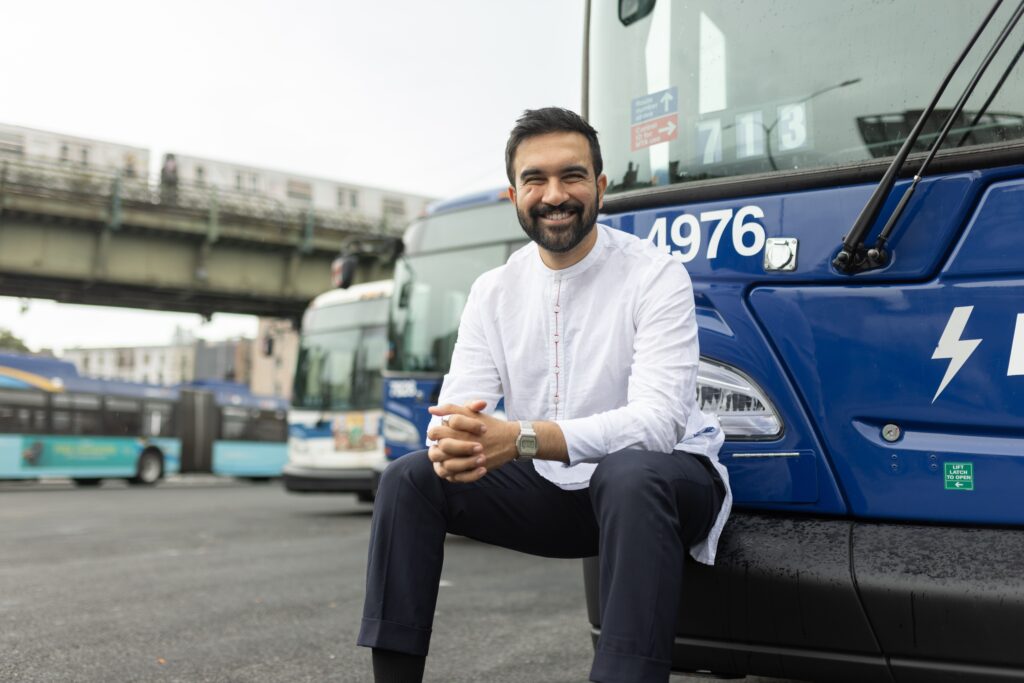

With Zohran Mamdani’s swearing in as New York mayor on January 1, many are trying to understand what does his victory tell us about politics in the US? Ziyad Motala tries to answer the question
In short, it reflects a stunning repudiation by a new class of younger and progressive voters of both the elites in the Democratic Party.
American politics often presents itself as a contest between two competing moral visions. In reality, the distance between the Democratic and Republican Parties is far narrower than their theatrics or optics might suggest. Beyond differences on race and cultural matters, both parties are committed to an economic order that concentrates wealth at the top. Both defend a global system in which the United States assumes the right to manage the affairs of other nations. Both maintain unwavering support for the Zionist project, although each cloaks that support in a different vocabulary. The dispute is over tone and technique rather than the foundations of power.
The Democratic Party wraps itself in the language of inclusion. It promotes diversity and makes space for women, Black Americans, LGBTQ persons, disabled people, and immigrants to rise in its ranks. It argues for modest redistribution, for protections against discrimination, and for a more compassionate rhetoric in public life.
Yet when the issue shifts from representation to the economic system itself, or to the architecture of the American empire, or to Washington’s blind allegiance to Israel, the party’s leaders are firmly entrenched in a familiar orthodoxy. The elevation of figures such as Barack Obama or Hakeem Jeffries is used as evidence of moral advancement, but these leaders ultimately defend the same strategic assumptions that have guided American power for decades. Diversity becomes a decorative achievement rather than a substantive challenge to entrenched interests.
Republicans dispense with that decorative language. Many are still mired in crude racism and evangelical religious fervor. Their commitments are more candid. They align themselves openly with the interests of capital. Their worldview on social and cultural issues is shaped by Christian nationalism. They read the scripture in a way that treats the modern State of Israel as a religious obligation. Their positions on abortion, LGBTQ rights, immigration, and social welfare reflect a religious world view and a narrow conception of citizenship grounded in cultural homogeneity. Where Democrats appeal to some concept of rights, Republicans appeal to revelation and racial undertones. Where Democrats invoke empathy, Republicans invoke rugged individualism.
These differences are real, particularly for those whose lives are shaped by the rights such as reproductive choices or health care, which Republicans seek to restrict. But they do not alter the deeper consensus. On foreign policy, on the logic of American power, on the prerogatives of Wall Street, and on the presumption that inequality is the natural order of things, the parties converge. The spectrum is wide on cultural questions and narrow on structural questions.
It is precisely this narrowness that makes the victory of Zohran Mamdani so significant. His election to the mayoralty of New York is not simply the triumph of a progressive candidate. It is a public rebuke of a Democratic establishment that treats representation as a substitute for justice. Mamdani refused the unspoken rule that candidates from marginalised communities must confirm the boundaries set for them. He spoke plainly about housing, inequality, policing, the cost of living, and the political economy that keeps ordinary New Yorkers in a permanent state of anxiety. He refused the ritual genuflection expected on matters of Israel and Palestine, relying on facts and not pandering to the Zionist or mobey class. The smear campaigns that attempted to weaponise his Muslim identity failed, not because prejudice has disappeared but because voters chose material truth over racial fear.
Mamdani’s victory exposes the fragile architecture of the Democratic paradigm. For decades, the party has relied on a disciplined coalition that would vote out of fear of Republican extremism, even when the party offered little more than symbolic inclusion and rhetorical warmth. The Mamdani electorate rejected that calculus. They refused to be governed by labels such as socialist or extremist. They refused to accept that a politics grounded in solidarity is naïve. They refused to pretend that the city could continue to function as an investment vehicle for the wealthy while ordinary people are priced out of the possibility of a stable life.
This is not a minor disruption. It is a warning. If a candidate who challenges real estate interests, Wall Street priorities, and the entrenched Zionist consensus can win in the nation’s largest city, then the party can no longer assume that diversity alone will secure obedience. Representation without transformation is losing its power to persuade.
The electorate in New York has spoken with a clarity that cannot be ignored. It wants politics that confronts the structural realities of inequality, not one that decorates them.
If American politics is to escape the suffocating narrowness of its current imagination, it will not come from the parties as they exist. It will come from candidates who refuse the choreography, who speak without fear, and who treat power as a responsibility rather than a performance. Mamdani’s victory is not the solution, but it is the signal. The voters have offered a simple truth. The country is ready for politics that does more than change the faces at the table. It is ready for a politics that changes the table itself.
The younger generation and progressives are no longer content with platitudes. If the US is going to course-correct, it depends on whether the Democratic Party is going to respond to the generation of voters who refused to buy into the agenda of Hillary Clinton and Kamala Harris that offered more of the same.